


"DeFi doesn’t ask for permission—it builds the future."
— Hayden Adams, Founder of Uniswap
DeFi is awesome, and with 30% of all Ethereum’s market cap locked in DeFi protocols, it has proven to be foundational for adoption.
However, the active DeFi market is built on the backbone of lending infrastructure, which is in itself purely fueled by the volatility of assets like Bitcoin, Ethereum, and tier 1 altcoins. This leads to a very lucrative, short, and sharp bull market followed by a long and daunting bear market. With this sort of uncertainty comes great risk for institutional investors like family offices, who require their investments to have a reasonable amount of stability over a long-term horizon.
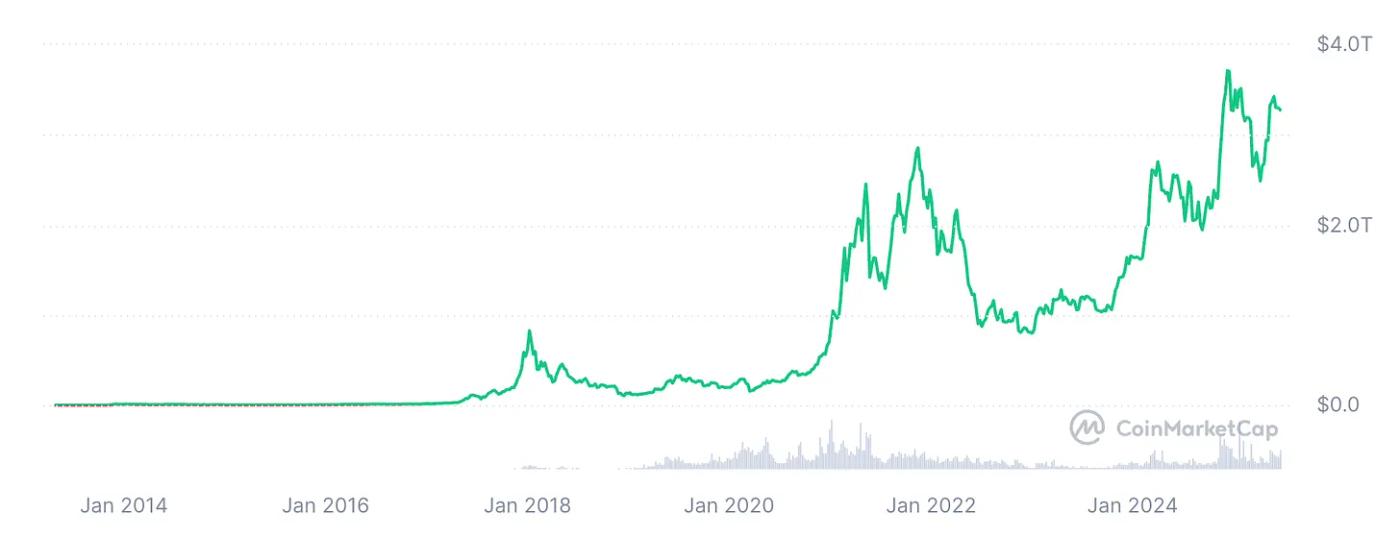
The chart above illustrates these cycles, which have had a profoundly negative impact, both psychologically and financially, on the crypto industry. The first cycle came with DeFi summer, which can be seen by the (now small) bump in market cap in 2018, followed by the second cycle of NFT summer in 2021-2022. There was a lot of hustling between the cycles to find lucrative opportunities, but they were mostly surrounded by fear and uncertainty. People didn’t want to believe that their cash cow had simply disappeared overnight…TWICE. I can tell you it wasn’t fun having lived through both of these cycles as a full-time software engineer and part-time investor in crypto; I didn’t hedge my bets.
Now enter RWAs.
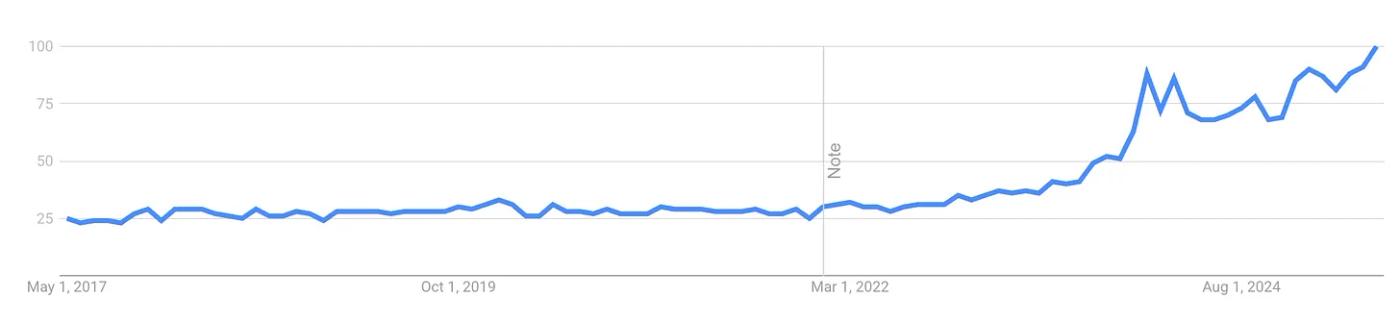
No, not risk-weighted assets—don’t worry, I’m not judging you if that’s where your mind went first—I’m talking about real-world assets. RWA was a term coined by early protocols to differentiate assets originating on-chain from those that originate off-chain, or in the real world. Recently, this new asset class has been getting a lot of mindshare, as you can see in the graph below (it’s unlikely there has been a surge in interest for risk-weighted assets). And in addition, if you superimpose the graph below with the market cap graph above, it is safe to say that RWAs will be dominating this bull market and will (hopefully) bring stability to future crypto cycles.
When RWAs exploded onto the blockchain scene with stablecoins like USDT, DAI, and USDC (in that order), it didn’t even have an asset class name. Now they are a foundational component of crypto because of their ability to facilitate real-world transactions. Therefore, stablecoins were very quickly adopted and became a stepping stone to a whole new world of opportunities for on-chain users and (naturally) led to the creation of tokenized treasury bonds and other RWAs. However, just moving assets like treasury bonds on-chain doesn’t exactly solve any real problems, and they’re almost certainly just looking to hijack some liquidity by targeting a younger demographic of investors (thanks BlackRock). Nevertheless, you have to start somewhere, and besides, it’s probably the best place to keep institutional capital happy while it waits for better opportunities.
But what are these opportunities?
Property! No, I’m joking, personally, I don’t know many people who want to hold a share of property on-chain, being a heavily long-term biased asset requiring a great deal of due diligence and regional knowledge to leverage. Maybe private equity? Tokenization of debt is much more popular, and companies always want money for a diverse array of business opportunities. But are you ready to bet your funds on miscellaneous activity? No real information is available to help you understand where your funds will go. In saying that, strict regulations in some jurisdictions and some good underwriting should mean you will eventually receive your principal back if something goes wrong, even if it takes 1-5 years. But these aren’t the principles blockchain and by association DeFi were built on, everyone should have the ability to participate, not just the Moody’s risk-accessed opportunities with backroom deals before they even hit the chain.
Lending protocols like Aave and Proof of Stake staking protocols like Lido provide permissionless and deep liquidity opportunities, whereas individually risk-assessed private equity faces significant deal flow bottlenecks due to a lack of trust and middlemen. So, it’s obvious just lifting and shitting existing traditional finance opportunities on chain isn’t ideal, and while it sounds like a curse, it’s actually a chance to serve a brand new market—there is a whole world of potential itching for capital to push their operations forward. These businesses are active in highly hostile banking environments through no fault of their own, other than the simple fact that they originated there. They tend to have deep ingrained expertise through a wealth of generational knowledge and a customer base yet to be fully capitalized. I’m talking about the emerging markets, if you haven’t guessed already. To some of you, this might sound like the wild west of investing, but I’ll forgive you because that is just what you have been told.
The growth of emerging markets is not just a trend; it’s a fundamental shift in the global economic order, redefining where opportunities lie.
- Jim O'Neill (economist who coined the term BRIC)
Our whole team was born in the emerging markets, but moved to the comfort of jurisdictions with manicured financial environments. So, most importantly, we understand the struggles emerging market businesses face, especially those partaking in international trade without a robust banking system to support them, leading to high failure rates due to high costs. At SPICE, we solve this by creating permissionless investable opportunities to help businesses across all jurisdictions. Inspired by the true trustless nature of blockchains, we employ gamification techniques and liquid staking used by Proof of Stake networks, like Ethereum, to create a trustless network of curators incentivized to bring on reliable deal flow from a real-world pipeline. These curators specialize in one or many classes of assets across the regions they operate and will drive expertise-driven investment opportunities to individuals and institutions all around the globe.
We will be starting with agri-commodities across South Asia and Oceania, through our in-house trading entity, Pinnacle (see our previous article below), while also working across mining and energy opportunities in South America.